"What we think, or what we know, or what we believe, is in the end, of little consequence. The only thing of consequence is what we do"

~ J. Ruskin

SUPPORT US!

DONATIONS:

Donations cover medications, supplies, and travel expenses for Haiti. 98% of donations go to direct patient care.

If you or someone you know would like to make a secure donation to support medical care for the Haitian people, please go to:


Wednesday, March 2, 2011

Back to School


One of the most heartening sights during our time in Haiti, whether in the city of Port au Prince or in the outlying rural communities, was seeing all the children en route too and from school. Many schools were damaged in the eartquake, and most children were out of session for months following the earthquake.


February 2010


February 2011

Those of you who followed us last year might remember that outside the window of our clinic 'room' at the Bel-Aire Church, was the devastating view of a primary school in rubble. Over 200 children died when the earthquake struck. Today the rubble has been cleared and a large UNICEF tent houses the school.

Shoe shine on the way to school

Haitians place a high value on education, though many families are unable to send their children to school. Aside from private and parochial schools, there is free public education in Haiti but the cost to cover uniforms, books, and supplies can be prohibitive. Only about 65% of Haitian children go to primary school and then only 20% to secondary school. Literacy is only 52%.

On the way home in the rural town of Dufort


Kids are kids. Running, playing, getting a free ride on a truck for a few meters.

A beautiful shot Aaron captured

-Mc


Monday, February 28, 2011

What's in a name

The Haitians always commented on my name with fascination. They liked it. “Are you French?”, they would ask. Well, yes, I do have some French mixed into what my mother calls the League-of-Nations heritage on her side of the lineage, but the truth is my name is more from the strong Irish heritage on my father’s side. I was named after my Great Aunt Claire, a woman my mother said was the “most generous and kind person I’ve met”. As a  young child, I took pride and responsibility knowing that story of my namesake.

It was not until I returned stateside that I learned why my name so fascinated the Haitians. It turns out Marie-Claire Heureuse Felicite
was the first empress of Haiti in the early 19th century. Her husband, Jean-Jacques Dessalines, was one of the founding father’s of Haiti. Slave for over 30 years, he was leader of the slave revolution against French rule and became the first ruler of an independent Haiti. He called himself Jacques I of Haiti. Today he is considered an icon of Haitian nationalism.

But, back to Marie-Claire. A nurse and educator, her life, too, was a revolution against injustices, though from a different angle. During the 1800 siege of Jacmel, she became known for her work with the wounded and starving. She even managed to convince Dessalines, who was one of the parties besieging the city, to allow some roads to the city to be opened, so that the wounded could receive help. She led a possession of women and children with food, clothes and medicine back to the city.

She was a contrast to her spouse, also, in her way of showing indiscriminate kindness to people of all colours, disregarding their ethnicity. A great opponent to the policy of her spouse toward the white French of Haiti, she saw to the needs of the prisoners, and despite the ire of Dessalines, saved many of them from his massacre on the French.

Jacques I of Haiti had a short-lived rule. He was assassinated after just two years in power. Marie-Claire lived in poverty from then on, first as consequence of her husband’s property being confiscated, and later by choice. Decades after her husband’s death she was offered a handsome pension by Emperor Faustin I of Haiti who wanted to demonstrate his admiration for her late husband. Having no admiration of her own for many of the ruthless tactics of Dessalines’ rule, she declined the money and lived in poverty to her death at the age of 110.

My parents I’m sure did not know of Empress Marie-Claire when contemplating baby names. However if they had, I’d be equally proud to have her as inspiration for my name.

~Mc

Saturday, February 19, 2011

Fondwa


Fondwa is a small mountain village approximately 1.5 hours from Léogâne. We left early in the morning and were happy to know that Jon Baptiste had come from Port au Prince this morning to drive us. Jon Baptiste is of course not only the best taptap driver in Haiti, but also one of our favorite people in Haiti.


The drive was as expected- rapid, hair-raising, and exciting. The roads to Fondwa certainly contain some of the most beautiful scenery in the country we've yet laid eyes on.


At the crest of a ridge we parked at a mobile container clinic ("clinic in a can") from Hospitals for Hope , much like the one set up next to the house in Léogâne. We were greated by the nuns who staff the clinic except for the one day a week when physicians come. As at the other locations, a large group waited there to meet us.


We saw patients by intermittent generator power through mid-afternoon with no patient being particularly critically ill.


After clinic we were graciously treated to lunch by the Sisters of Charity. The nuns prepared everyone a simple but delicious meal of beans, rice, beats, corn, and fish.


Before lunch we enjoyed the company of the happiest and healthiest dog in all of Haiti.


To learn more about Fondwa and the region, please watch The Road To Fondwa:


-Aaron

Friday, February 18, 2011

Alive!

We have been in the Haitian countryside for the past 5 days with no communications since we landed. We are alive and well and will update here shortly!

-Aaron & Maryclaire

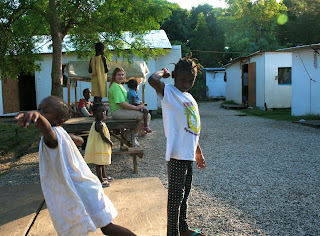
Clinic in a Can. Orphanage in a Tent.


Right next to our volunteer center base camp is a "clinic in a can": cargo container fitted with three 7 x 10 rooms that function as two fully equipped doctor's office and pharmacy. This is normally staffed by a Haitian doctor employed by Heart to Heart. He was off today, so I filled in for him as Aaron and Sue (our good friend and nurse who was in Haiti with us this time last year) took the mobile out to a community church in Petite Riviere.


There are three bleacher sized benches under a wide white tarp in the front yard. Patients begin lining up at 7:30 am. Today the seats filled with many mothers and children. My youngest patient was 29 days old. Fortunately, she was not very sick. Unfortunately, I did see a 20 year old patient, brought in by her mother, who was in fulminant liver failure: her abdomen was as large as a term pregnant uterus, her limbs skeletal, her breaths short and fast. I sent her to the closest MSF hospital (doctors without borders). What she needs is a full ICU admit. Even with that, I'm not sure she will survive.

In between these patients I saw ailments ranging from common cold, fungal skin infection, miscarriage, and ulcerations from scabies.


Later in the afternoon, our Haitian born, US-bred Field Director took us to visit a local orphanage 1/2 mile down the street. It is home to 45 children ranging in age from 2 weeks to 12 years. One of the two-weekers arrived only last night, dropped off by a mother unable to care for her. I was immediately approached by a 3-year old, with out-stretched hands who wanted to be held. According to staff, he is quick to ask all visitors to hold him. I held him for most of the time we toured the facility.

The tour was given by Donna Tente who works with CityTeam ministries. She secures donations and grants for the orphanage needs and spends a few weeks every couple months at the orphanage helping out.


The orphanage used to be housed in a building. Since the earthquake it is a series of tents and recently-constructed wooden buildings. The plan is to have the orphanage rebuilt in a year. The children are schooled in French and English, have a playroom of games and toys, and keep the company of puppies, cats, and goats. The goats, like the turkeys, will become dinner. Each child has a small box of items of their own--clothes, toys, etc. The rest is shared, including Sunday dresses.


It is a well-run organization with happy children.


If you would like to volunteer or help fund items of need, or even sponsor a child, please go here:


Tomorrow, we head out to the mountain village of Fondwa, and return at days end to Port-au-Prince to continue work at the Bel-Aire clinic Saturday morning. Once back in the capital city, we will have access to internet, where we will post these blogs.


~Mc


Please note: we will post more pictures when stateside. The process of posting here is extremely protracted given the internet connection and PC program. [Update- photos now added.]

Monday, February 14, 2011

Haiti Revisited

2.14.2010

Our first day at clinic began before our previous day was over. We arrived into Haiti at 8 am after traveling all night, with a quick nap on the Ft Lauderdale airport floor. Shortly after arrival, and clearance of our four large bins of medications through customs, a flatbed Heart to Heart truck delivered us to the Bel Aire clinic at it's opening time of 9 am. Our arrival was like a surreal call shift, where you are up all night, and then take care of patients throughout the morning, though with the twist of starting the shift on a crisp bright New Mexico afternoon and ending the following afternoon in a health clinic on then second floor of a Haitian church overlooking the seaports and the commerce, education and life that has sprung up on the streets, amidst the considerable rubble that remains.

Children in school uniforms and backpacks are a common site now. The basement of the Bel Aire church, even, houses several classrooms filled with studious children of various ages in blue and grey uniforms.

The clinic too is familiar, but improved. There are now two Haitian doctors on staff, and a Haitian nurse who does triage. We have basic laboratory capabilities, and an expanded pharmacy staffed by a Haitian pharmacist. And we have our translators. The same translators we had last year. It was so wonderful to see them! Especially Calixte.

The patients lined up in similar fashion, waiting on pews to be seen. We saw many of the same aliments as last year--general aches and pains, insomnia, reflux--but also cases of more severe illnesses: malaria, strep throat, cholera, surgical hernias, acute renal failure, ulcerated scabies infections, kidney infection. And I had the lab capability to tell a woman, that yes, she was feeling nauseous from pregnancy and got her started on pre-natal vitamins.

It was a busy, tiring, rewarding day that ended with a truck ride to the volunteer center in Leogane. (The city that was the epicenter of the earthquake.) We will spend the next couple days setting up mobile clinics in the surrounding communities.

Bon nuit (good night)
~Mc

An Exhausting Arrival

Our flight out of Albuquerque was quick and painless but all of my lingering sickness was still there.

Dallas to Ft. Lauderdale was no real issue either but when we arrived in Florida it was 12:21 and the airport was closed. We needed to check back into the airport in less than four hours and there was no point in getting an hotel for the evening. We went down to the main lobby and laid out our thin sleeping bag liners, crawled under the plastic seats, and stole fitful sleep while the overhead announcements reminded us of where we were.

In the morning, we checked back in through the gate, then bought last minute food, changed into scrubs, and boarded the last leg of our flight to Port-au-Prince.

Landing in Haiti was surreal. When we traveled immediately after the earthquake we had to pass through the Dominica Republic and take U.S. Embassy transport across Hispañola to arrive in Port-au-Prince. This time we were able to land directly into the country. I thought I was fine until I saw the first crack in a window and wall, and I choked back tears. In minutes though any sadness was overcome by a positive energy as live music blasted through the open areas, played by musicians hired by Digicel, a local communications company.

Our push through customs was quick, and we met new members of our team.

Immediately we traveled by open-air truck truck to Belaire, and within an hour of landing in Haiti, were back in the church clinic and seeing patients.